New Canaan homeowners don’t want a job that looks good for one summer—they want a finish that survives Connecticut swings. The “best time to paint” here isn’t a month on a calendar; it’s a set of conditions that protect curing: truly dry surfaces, stable overnight temperatures, and a window long enough to let primers and finish coats form a strong film. Shade patterns matter more than most people think, especially on wooded lots and north elevations. This guide gives a practical planning method you can use as a homeowner: how to spot high-risk days, how pros sequence elevations, and how timing connects directly to paint lifespan.
The core rule: cure protection beats “warm weather”
Warm afternoons can be misleading in Connecticut. If temperatures drop sharply at night or moisture forms as dew, coatings can be stressed before they fully stabilize. That’s why timing is really about cure protection: you want surfaces dry at application and you want overnight conditions that stay within product requirements long enough for the film to form correctly. A schedule that ignores overnight lows or shade-driven dampness may “finish on time” but can reduce longevity—especially on trim edges and caulk seams.
The day-of checks that prevent failure
- Confirm surfaces are fully dry (especially shade elevations)
- Avoid painting into likely evening dew conditions
- Verify overnight lows for the next two nights
- Keep a rain buffer that matches your scope
New Canaan micro-exposures that shift timing
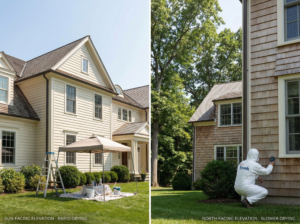
New Canaan has a mix of open exposures and wooded properties. That changes drying time: a sun-facing wall can be ready while a shaded elevation remains damp. The practical impact is sequencing and patience—especially after rain. Homeowners who try to “force” the schedule often see uneven weathering later, where one side holds up and the other side shows mildew staining or edge failure first.
Two common high-risk zones
- North-facing elevations under deep tree cover
- Trim transitions near gutters, valleys, and splash areas
Season-by-season planning table for New Canaan
Use this table to plan, then confirm with the weekly forecast and product technical data. The goal is not perfection—it’s reducing risk by avoiding predictable high-risk stretches.
Planning table (what usually works best)
| Period | Typically best for | Primary risks |
| Mid–late spring | Main repaints begin | Rain clusters, pollen film, cool nights |
| Early summer | Productive windows | Humidity spikes, pop-up storms |
| Mid-summer | Long daylight | Hot surface temps, flash-drying on sun walls |
| Early fall | Often the steadiest | Nights cool quickly; dew becomes limiter |
| Late fall | Small scopes only | Short days, cold nights, frequent dampness |
| Winter | Avoid full exteriors | Cure failure risk, wet substrates |
Architecture changes the “best day” in New Canaan
New Canaan includes both trim-forward traditional homes and modernist architecture where crisp edges and large glass areas make cleanliness and control non-negotiable. On modern homes, wind and dust matter more because overspray and masking failures are obvious. On trim-heavy exteriors, dew and cold nights matter more because edges, joints, and profiles are where failure starts.
Modern homes: choose calmer wind + cleaner days
Trim-heavy homes: choose longer dry windows for detail work
How professionals sequence elevations to protect curing
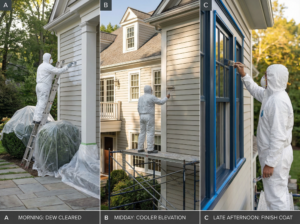
A strong crew doesn’t treat the house as one surface. They move across elevations based on exposure: they wait for shade sides to fully dry, avoid sun-baked walls during peak heat, and plan stopping points that keep the site protected if weather shifts. This is how timing becomes a durability tool, not just a calendar decision.
The simple sequencing model
- Start after dew clears (shade sides first)
- Shift away from peak-heat walls mid-day
- Return when surface temperatures stabilize
FAQs
Is summer always best because it’s warm?
Not necessarily. High humidity and storms can shrink safe cure windows.
Is early fall safer than spring?
Often, but cooler nights and dew can limit the window quickly.
Why do shaded sides fail sooner?
They stay damp longer and experience more mildew pressure.
How many stable days do we need?
Enough for application and for the coating to cure through stable nights—scope-dependent.
What’s the most common scheduling mistake?
Picking dates by month instead of surface dryness and overnight conditions.
See the Exterior Painting Process Built for CT Weather
If you’re still comparing options, start with the process. Our exterior system is built around prep quality, protection, and safe cure windows—so you can judge workmanship before price. Explore our New Canaan exterior service page and see what’s included, step by step.